


Experimental Applications
Below are a selection of example applications for the PImMS sensor.
|
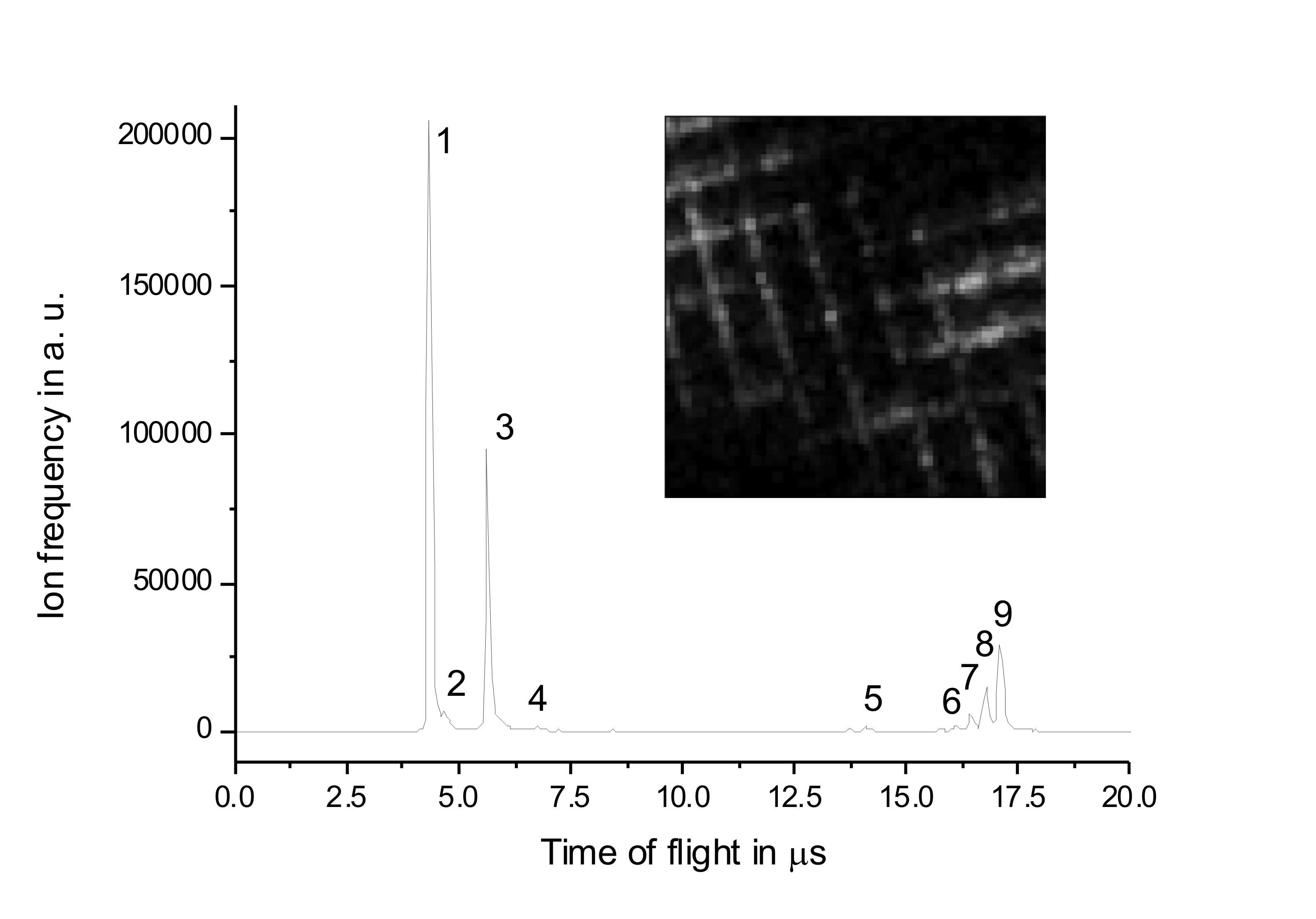
| A mass spectrum of crystal violet with the MALDI matrix CHCA. The analyte was applied in a grid pattern which is then resolved in the imaging. |
Spatial Imaging of Chemical Compounds
Mass spectrometry is a powerful analytical technique of which there are a number of different variations. Time-of-flight mass spectrometry seperates a sample into species with different mass to charge (m/z) ratios. A sample is desorbed into the gas phase and ionised. These ions are accelerated by an electric field and species with different m/z ratios reach different final velocities. These species then arrive at the detector at a time corresponding to their m/z ratio.
By controlling the curvature of the accelerating field, it is also possible to control the position on the detector at which the ions hit. With the correct field ions can be made to map onto the detector dependent on their initial position when they were ionised. This means that not only is the chemical information extracted from the time-of-flight, but the original position of a given ion is observed.
One type of detector used in these experiments consists of microchannel plates which convert incident ions into a shower of electrons amplifying the signal, followed by a scinitillating screen which converts these electrons into light. A camera can be used to capture the image relating to the m/z region of interest.
By using the PImMS sensor in place of a standard framing camera, all images for all m/z ratios can be obtained within the same experimental cycle. This can greatly reduce the time needed to collect a full data set.
|
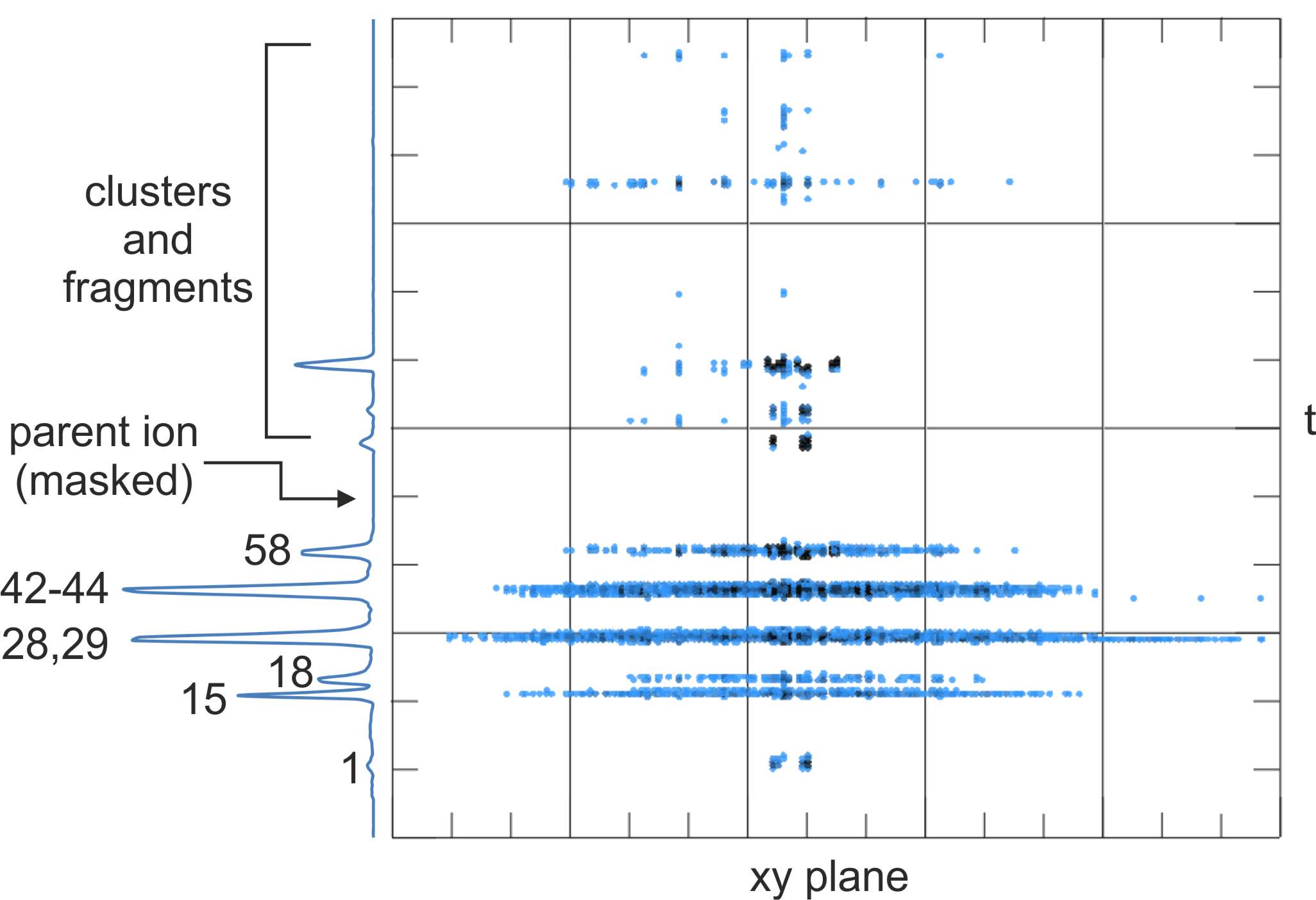
| A three-dimensional representation of the ion velocity distributions recorded following 193 nm photolysis of DMF. The data consisted of over 4000 experimental cycles, and all fragments were recorded on each laser shot. The m/z ratios for the recorded data is shown to the left of the graph. |
Molecular Velocity Mapping Experiments
By studying the velocities of the products of either reactive or non-reactive collisions, or photolysis experiments, features of the underlying processes can be learned. These experiments require that the products of interest are ionised and these ions are then accelerated towards a position sensitive detector. By manipulating the accelerating electric field it is possible to map ions with the same initial velocity to the same point on the detector. Ions of different mass to charge (m/z) ratios will be accelerated to different final velocities and so will hit the detector at different times.
Velocity mapping experiments use spatialy resolvable detectors similar to the ones described above. Again a conventional framing camera would then be used to obtain the image on the scintilating screen corresponding to a given m/z range. This requires the experiment to be repeated for each species of interest. The PImMS sensor allows all the products to be imaged simultaneously reducing the time needed to record the data.
|
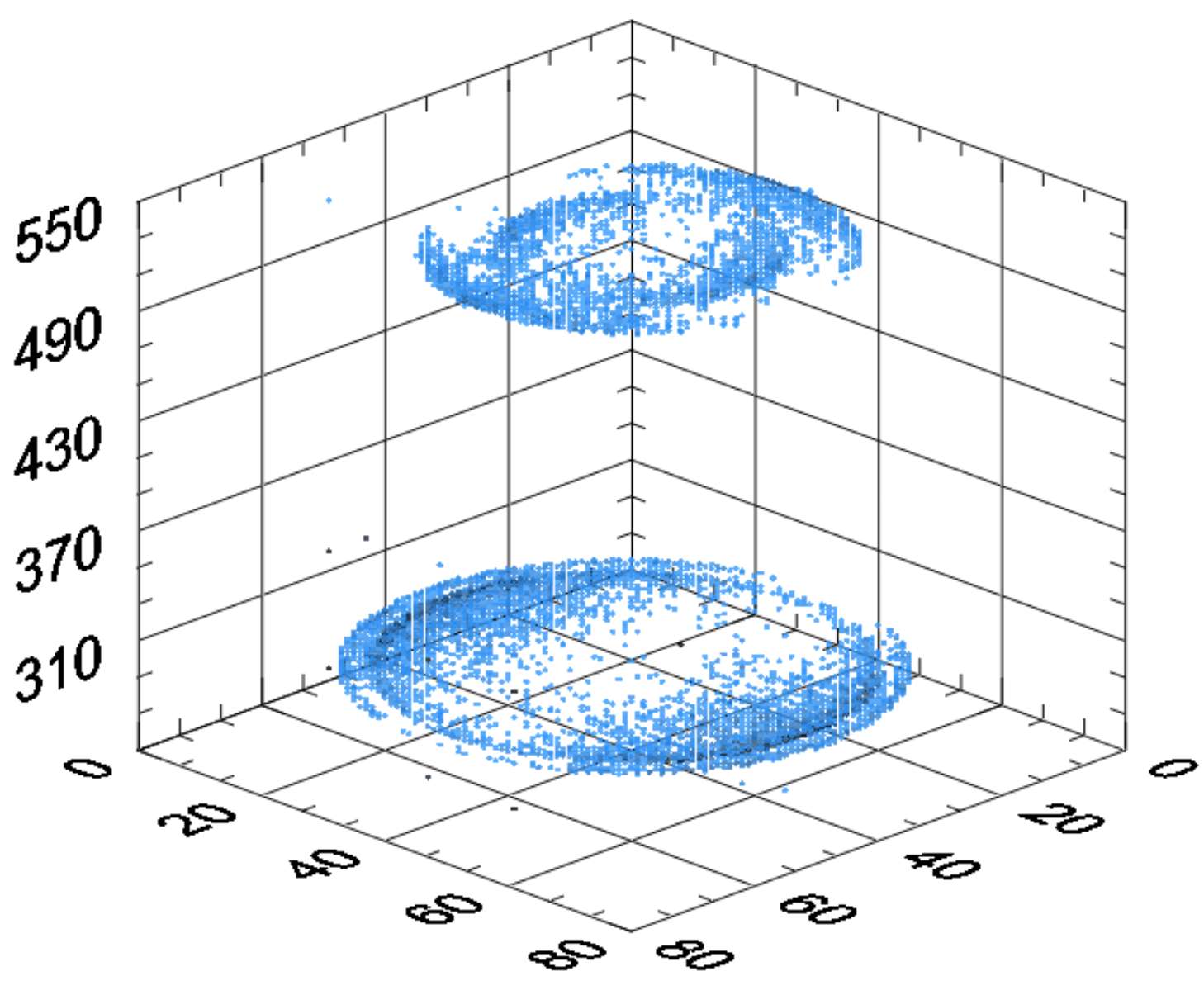
| A three-dimensional representation of the electron and fragment ion velocity distributions recorded following photolysis of Br2 at 446.32 nm, integrated over 20,000 laser shots. |
Coincidence Imaging Experiments
Expanding on the concept of velocity mapping experiments above, it is possible to look at the relationship between two products of the same single process. The image to the right shows the electron and bromine ion velocity distributions after photoionisation.
By initially setting the electric field to accelerate negative particles the electron image can be detected. The electric field is then switched and the bromine ions are accelerated towards the detector. This switching has to occur before the bromine ions have left the acceleration area.
As the PImMS sensor can image multiple ions within a single time-of-flight, both the electron and bromine image are obtained for a single laser shot. This means that, by using statistical analysis methods, a correlation between the electron and bromine images can be deduced. This can happen even with a high event rate allowing for faster acquisition.
|
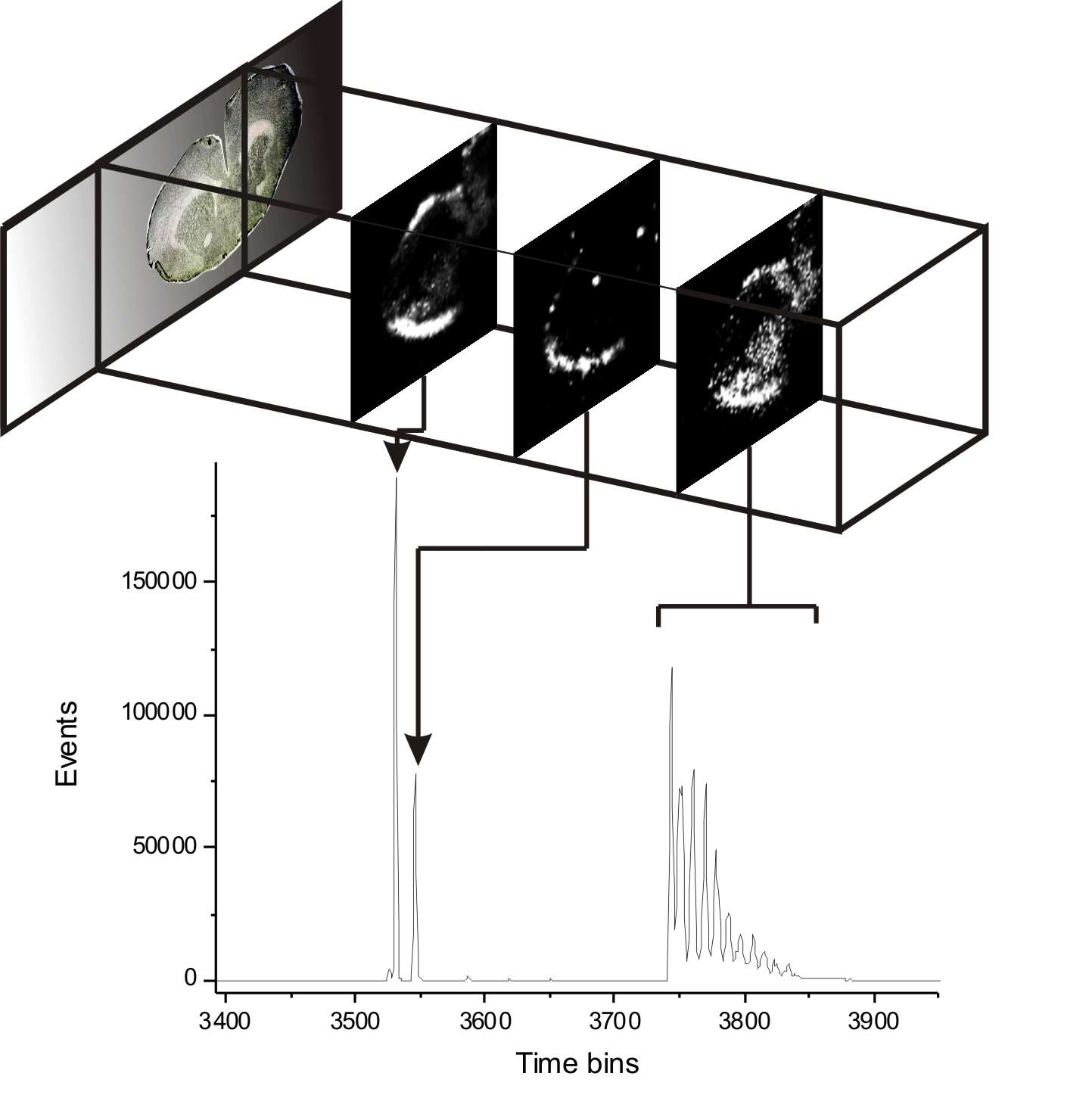
| The localisation of different compounds in a biological sample can be obtained using spatial imaging techniques. |
Biological Tissue Imaging
A further application relevent to the spatial imaging concept outlined above is the chemical imaging of biological tissue samples. This is very relevant in areas such as drug research where, for example, the localisation of an administered drug is of great importance.
With biological tissues the increased speed of analysis offered by the PImMS sensor means that samples suffer less degredation associated with ex vivo analysis. Less degradation means that results are more reliable and that further analysis using different techniques could still be an option afterwards.